

Car Accident Attorney in Miami, FL
It Wasn't Supposed to Happen. But It Did. Now Let's Make Sure You're Protected
Miami Car Accident Attorneys
A Miami car accident attorney is a personal injury lawyer who represents motor vehicle collision victims in Miami-Dade County. Under Florida’s no-fault PIP system, crash victims must seek medical evaluation within 14 days or permanently forfeit $10,000 in PIP benefits. Under Florida’s 2023 tort reform (HB 837), any victim found more than 50% at fault recovers nothing. CHG Lawyers fights for you from the moment you call.
Miami leads Florida in car accidents — 67,000+ reported collisions annually in Miami-Dade County, more traffic fatalities than any other Florida county, and a 26.7% uninsured driver rate. According to FHSMV's Traffic Crash Statistics, Miami-Dade has a high crash rate for three main reasons: massive multi-car pileups on I-95, rideshare accidents in Brickell, and pedestrians being hit in Little Havana — victims face insurance companies with legal teams already working, evidence that disappears within 72 hours, and a changed legal landscape that makes experienced representation financially decisive.
Free consultation available 24 hours, English and Spanish.
The attorney you meet on day one is the attorney who goes to trial.
Get Your Free Case Evaluation
Takes 30 seconds. Our team will respond in under 10 minutes.
Recent Recoveries for Accident Victims
Insurance Research Council data shows that represented Miami car accident victims recover 3.5 times more than unrepresented victims — a gap that compounds dramatically in serious injury cases worth hundreds of thousands to millions of dollars.
South Florida
Miami-Dade County
Vehicle collision
Pedestrian accident
Two things cannot wait after any Miami car accident: seek medical evaluation within 14 days or you permanently forfeit $10,000 in PIP benefits — and call an attorney before giving any recorded statement to any insurer, including your own.
Florida's No-Fault PIP System — What Every Miami Victim Must Do First
Florida's no-fault insurance system under Florida Statute 627.736 governs the first phase of every Miami car accident claim. It contains rules that, if missed by a single day, permanently destroy thousands of dollars in benefits. Understanding these rules is the most financially consequential thing a Miami accident victim can do in the first 48 hours.
The 14-Day Medical Treatment Rule — Non-Negotiable
Florida requires all vehicle owners to carry $10,000 in Personal Injury Protection (PIP) coverage. PIP pays 80% of your medical expenses and 60% of your lost wages — from your own insurer, regardless of fault. The rule that destroys more Miami car accident claims than any other: you must seek formal medical evaluation within 14 days of your accident. Miss this deadline by a single day and you forfeit all $10,000 in PIP benefits permanently, with no exceptions.
Many Miami accident victims wait to see if symptoms resolve — a delay that wipes out no-fault benefits and gives insurers evidence that injuries were not serious. Whiplash, back pain, headaches, cognitive changes, and dizziness from soft tissue trauma routinely worsen in the days following impact. Seek evaluation within 24 to 48 hours. Document every symptom, even minor ones.
When You Can Sue the At-Fault Driver for Full Damages
Your $10,000 PIP is consumed quickly — Miami emergency room visits ($2,000–$8,000), imaging ($500–$2,000), and specialist care exhaust it fast. Once PIP is exhausted, you pursue the at-fault driver's bodily injury liability coverage. To sue for pain and suffering — often the largest component of a serious injury recovery — Florida requires meeting the serious injury threshold: permanent injury within a reasonable degree of medical probability, significant and permanent scarring or disfigurement, or significant and permanent loss of an important bodily function.
CHG Lawyers evaluates serious injury threshold qualification from the first consultation, working with medical specialists to document injuries precisely to support maximum recovery beyond the PIP ceiling.
Florida's 2023 Tort Reform
Florida's 2023 Tort Reform Act (HB 837) reduced the negligence statute of limitations from 4 years to 2 years. Evidence disappears in 72 hours. Call now.
Florida's 2023 Tort Reform — How It Changed Every Miami Car Accident Case
Florida's 2023 Tort Reform Act (HB 837, effective March 24, 2023) is the most significant change to Florida personal injury law in decades. Miami victims bear its sharpest impact — and Miami insurance adjusters have studied exactly how to use it against unrepresented claimants.
The 51% Comparative Fault Bar — How Adjusters Use It
Under Florida's new modified comparative negligence standard, any plaintiff found more than 50% responsible for an accident recovers nothing. The previous pure comparative fault system allowed even a 99%-at-fault plaintiff to recover 1% of damages. Miami insurance adjusters have systematically weaponized this change — aggressively arguing that victims were speeding, distracted, following too closely, or failed to brake — specifically to push victim fault above 51% and eliminate all recovery.
Never give a recorded statement to any insurance company — including your own — before speaking with CHG Lawyers. Adjusters are trained to extract statements that establish contributory fault. What you say in the first 48 hours can determine whether you recover hundreds of thousands of dollars or nothing.
How CHG Lawyers Counters Comparative Fault Arguments
We build comparative fault defense from day one. Our accident reconstruction experts use engineering analysis, surveillance footage from Miami businesses (critical: most cameras delete within 72 hours), dashcam footage, skid mark analysis, and black box data to establish the at-fault driver's full negligence. We preserve evidence immediately upon retention — before it disappears, before the other side's narrative is the only one that exists.
Miami's Most Dangerous Roads and Crash Corridors
Highway Accidents — I-95, SR-836, SR-826, SR-112
FHSMV crash data identifies Miami's highway system as Florida's most dangerous. I-95 through downtown Miami and the I-95/SR-826 interchange in Hialeah generate catastrophic multi-vehicle crashes from speed, congestion, and lane-change conflicts. The Dolphin Expressway (SR-836) from Miami International Airport to Brickell produces constant rear-end and merge-point collisions. The Palmetto Expressway (SR-826) through Hialeah and Doral carries enormous commercial and commuter traffic with chronic accident patterns at major interchanges. SR-112 (Airport Expressway) sees heavy commercial truck and passenger vehicle conflicts near MIA.
Surface Street Dangers — Little Havana, Hialeah, Brickell, Wynwood
NW 7th Avenue through Little Havana records some of Miami's highest pedestrian fatality rates, driven by heavy foot traffic and inadequate crossing infrastructure. US-1 (Biscayne Boulevard and South Dixie Highway) generates high-frequency intersection crashes through Coconut Grove, Coral Gables, and South Miami. Brickell Avenue and downtown Miami streets see intense rideshare and commercial vehicle traffic with distracted driving crashes near hotels and nightlife corridors. Hialeah surface streets — West 49th Street and Palm Avenue — carry enormous pedestrian and bicycle traffic creating constant vehicle-pedestrian conflict zones.
Rideshare and Commercial Vehicle Accidents
Miami's Uber and Lyft density creates unique insurance complexity. Rideshare coverage shifts based on driver app status: personal policy when app is off, limited $50,000 coverage when app is on but no passenger, and the company's $1 million commercial policy when a passenger is aboard. Commercial vehicle accidents — delivery trucks, corporate fleets, airport shuttles — involve employer respondeat superior liability and commercial policy limits that dwarf personal auto coverage. CHG Lawyers navigates Miami's full commercial and rideshare insurance landscape to maximize recovery from every available source.
What Damages Can Miami Car Accident Victims Recover?
When the serious injury threshold is met, Florida law allows recovery of all past and future medical expenses, lost wages, loss of earning capacity, vehicle repair or replacement, pain and suffering, emotional distress, loss of enjoyment of life, and loss of consortium. For catastrophic injuries — spinal cord damage, traumatic brain injury, severe burns, amputation — lifetime care calculations and vocational impact assessments produce multi-million-dollar valuations that require specialized expert testimony and thorough documentation. In fatal crash cases, a wrongful death claim may also apply.
Uninsured Drivers in Miami — 26.7% of Miami-Dade Drivers Have No Coverage
With 26.7% of Miami-Dade drivers uninsured — Florida's highest county rate — uninsured motorist (UM) coverage is the most important protection Miami drivers carry. When an uninsured driver injures you, your UM coverage becomes the primary recovery source for pain and suffering beyond your PIP limits. Underinsured motorist (UIM) coverage bridges the gap when the at-fault driver's liability limits are insufficient for serious injuries.
CHG Lawyers evaluates your complete insurance stack — PIP, UM/UIM, health insurance, umbrella coverage, and the at-fault driver's policy — to maximize recovery from every available source. Most unrepresented Miami car accident victims never identify all the coverage available to them.
Why Choose CHG Lawyers for Your Miami Car Accident Case
Our attorneys are well-versed in Miami-Dade courtrooms and jury expectations, possessing extensive trial experience. We understand precisely how insurance defense teams prepare their cases within this specific jurisdiction.
PIP system expertise — immediate guidance on the 14-day rule, serious injury threshold documentation, and the complete insurance stack available to you before a single statement is given.
2023 tort reform defense — accident reconstruction, surveillance evidence, and comparative fault counter-arguments built from the first day of representation.
Bilingual English and Spanish — serving Miami's 69% Hispanic community with genuine cultural competency, not just translation services.
5.0 Google rating. Contingency fee — no fees unless we win.
Do Not Give Statements
The at-fault driver's insurer and your own will contact you. Do not give recorded statements to any insurer.
Under the new 51% bar, early statements can be used to push fault above 50% and eliminate all recovery.
Call Us For Immediate Help14-Day Medical Rule
Florida PIP requires formal medical evaluation within 14 days of your accident.
Miss by one day: $10,000 PIP benefits gone permanently. No exceptions.
What to Do After a Car Accident in Miami
Call 911
Always file a police report. In Miami, this documents the at-fault driver's insurance status immediately.
Seek Evaluation
You have exactly 14 days to see a doctor or you permanently lose $10,000 in Florida PIP benefits.
Take Photos
Document vehicle damage, the scene, and your injuries before evidence disappears or vehicles are moved.
No Statements
Do not give recorded statements to any insurance adjuster. They are building a comparative fault defense.
Call CHG Lawyers
We investigate your insurance stack, PIP limits, and at-fault driver coverage from day one.
Why Miami Families Choose CHG Lawyers
Attorneys with extensive car accident trial experience. Deep understanding of Miami-Dade courtrooms.
If I could give 5 more stars I would! Partner Igor Hernandez handled my case from the very beginning. He's knowledgeable, well versed in personal injury laws, and works diligently to achieve the best outcome.
These attorneys are amazing! I had a case with another lawyer I had to fire because he wouldn't pay attention to my case. CHG took my injury case over, got straight to work, and resolved it faster than expected.
I must say I had the best experience possible. Everyone I talked to was fantastic. John represented me and did an awesome job. I am very happy with the outcome.
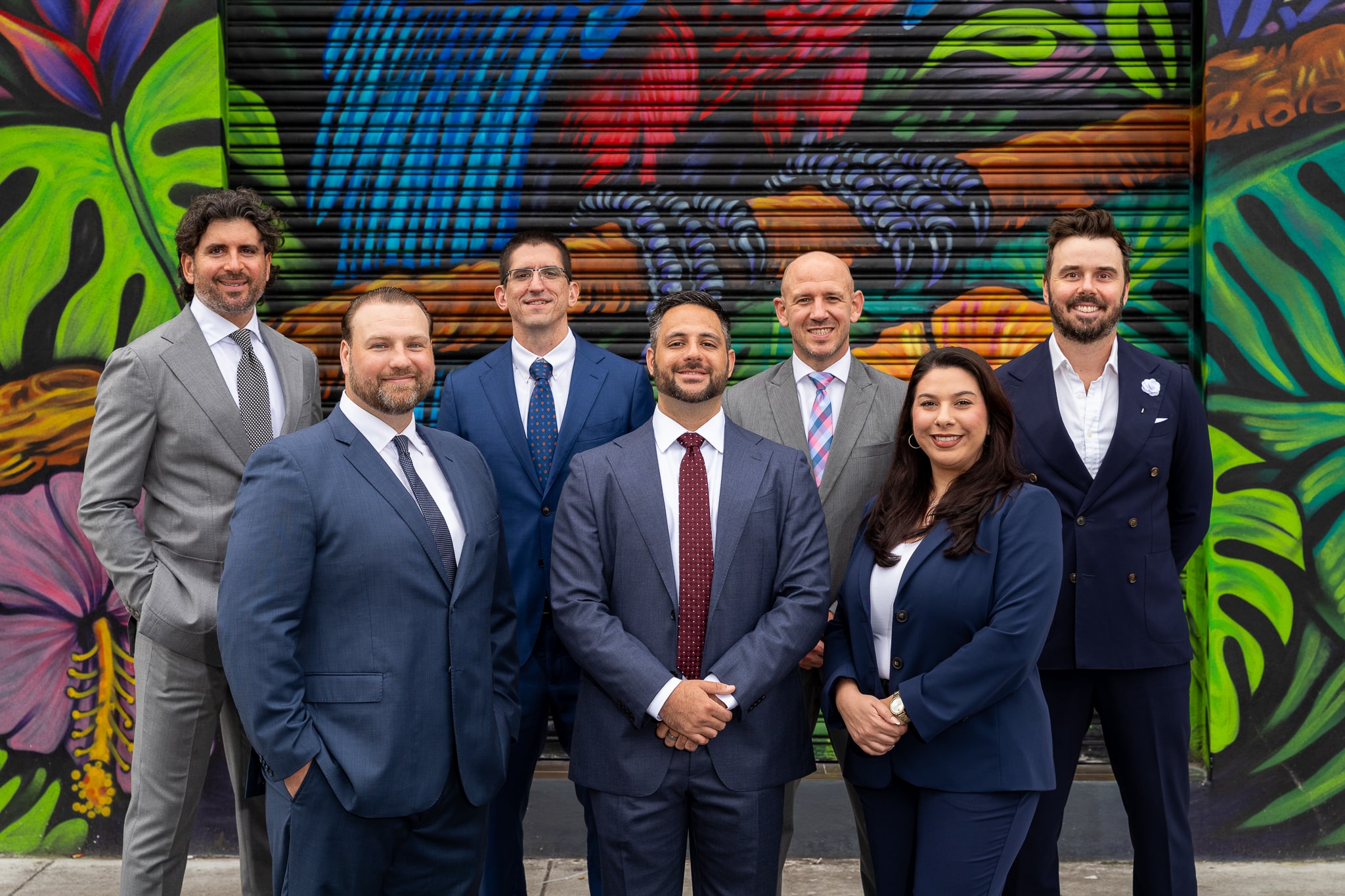
Meet Your Personal Injury Team
Let Us Fight For The Compensation That Is Owed To You
We’re here to fight for you, and we won’t rest until we get you the outcome you deserve.
Miami Car Accident FAQs
How long do I have to see a doctor after a car accident in Miami?
Under Florida's no-fault PIP law, you have exactly 14 days from the date of the accident to seek a formal medical evaluation. If you miss this deadline by a single day, you permanently forfeit your $10,000 in PIP benefits, with no exceptions. We strongly recommend seeking medical evaluation within 24 to 48 hours to fully document all symptoms.
I was hit by an uninsured driver in Miami. Who pays for my medical bills?
With 26.7% of Miami-Dade drivers operating without insurance, this is a very common scenario. Initially, your own Personal Injury Protection (PIP) will cover 80% of your medical bills and 60% of lost wages up to $10,000. Beyond that, if you carry Uninsured Motorist (UM) coverage on your policy, it acts as the primary recovery source for pain, suffering, and additional damages. CHG Lawyers investigates all available policies in your household to find coverage you may not know you have.
Will my claim be reduced if I was partially at fault for the crash?
Under Florida's 2023 Tort Reform Act (HB 837), Florida now follows a modified comparative negligence standard. This means if you are found to be more than 50% at fault for the accident, you recover absolutely nothing. Adjusters are trained to use any statement against you to push your fault over this 51% bar. This is why you must never give a recorded statement to any insurer before securing representation.
Can I sue the at-fault driver for pain and suffering in Florida?
Yes, provided your injuries meet Florida's 'serious injury threshold.' Once your PIP is exhausted, you can pursue the at-fault driver's bodily injury liability coverage for pain and suffering if you have sustained a permanent injury within a reasonable degree of medical probability, significant and permanent scarring or disfigurement, or significant and permanent loss of an important bodily function. CHG Lawyers works with specialists from day one to precisely document injuries that meet this threshold.
I was injured in a crash with an Uber/Lyft in Miami. Whose insurance applies?
Rideshare accidents in Miami involve complex insurance layers depending on the driver's app status. If the app is off, their personal policy applies. If the app is on but they haven't accepted a ride, limited contingent coverage applies. If they have accepted a ride or have a passenger, the rideshare company's $1 million commercial policy is active. CHG Lawyers navigates this commercial landscape to identify and secure the highest possible coverage for your claim.
The insurance adjuster is calling me for a recorded statement. Should I give one?
No. Never give a recorded statement to any insurance company—including your own—without an attorney present. Adjusters are actively building their defense from the moment the claim is reported. They are trained to extract statements that can establish contributory fault on your part, especially under the new 51% bar. Let CHG Lawyers handle all communication with the insurers.
Contact Our Miami Car Accident Attorneys
The insurer handling your claim began building their defense the moment you reported the accident. CHG Lawyers begins fighting for you the moment you call.
Call Us Today. Free Consultation.Call (305) 501-80212525 Ponce de Leon Blvd., Suite 300, Coral Gables, FL 33134
Email: [email protected] · 24/7 · English & Spanish
CHG Law
With years of experience in the field of personal injury law, the attorneys at CHG Law in Coral Gables, Florida, near Miami, have a proven track record of success. They have helped clients recover millions of dollars in compensation, and they are ready to help you too.
-
2525 Ponce de Leon Blvd. Suite 300
Coral Gables, FL, 33134 - (305)-501-8021
- [email protected]
You Don't Pay Until We Win
Don’t be held back by your injuries. Give us a call or submit the simple form below to speak with a lawyer within 24 hours.